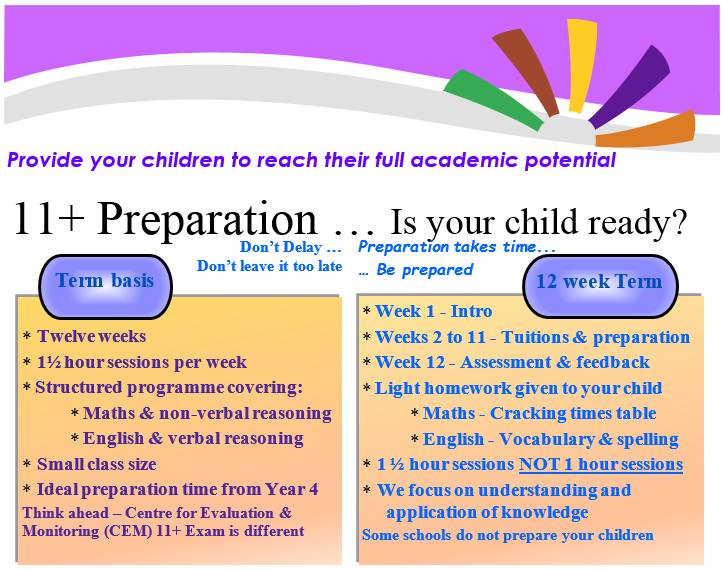

 We received feedback for parents and guardians and we build are aims to meet your expectations.
In line with our core principles IQ-CARE© and our finding we have found that:
- Initially the child may be struggling in class that some parents may not be aware of!
- A qualified tutor charges £15 - £30 an hour! Our fees are fixed for the entire academic year, currently at £20 per hour (Sep 2015)
- Other private tuitions give children too much homework that affects them mentally in line with school homework
- Other private tuitions rely on the parents to check their children's homework and in some cases the parents end up teaching their children by showing them where they have gone wrong
- Other private tuitions focus on practice exercises with the hope that the children pickup their mistakes and if the format changes then the children may find it difficult to adapt to new style of questioning
- Other private tuitions can have upto 30 children in a class and shy children may be left behind
- Our aims are:
- To build child’s confidence
- To improve children's understanding and apply their knowledge in given situations
- Provide clear, short and concise sessions (teaching in bite-chunks) for better understanding
- Provide explanations with examples to contextualise learning
- Carryout assessment through practice questions for preparation in a timed environment
- To track and monitor children's progress; review broken-down by topics
- To provide a lighter homework to prevent children being over worked outside the teaching session
- No parent’s teaching required!
Unique teaching style to improve understanding and application of knowledge to children of varied abilities; ideal if you your children start from Year 4:
- Key Stage 1 & 2
- Verbal and non-verbal reasoning
- English
- Reading
- Vocabulary and meaning of words
- Prefixes and suffixes
- Spelling and use of a dictionary
- Grammar
- Comprehension - fiction, nonfiction, poetry, plays, reference books
- Retelling stories, myths & legends previously read
- Writing
- Planning when writing
- Sentence structure, vocabulary and grammar
- Spelling
- Maths
- Number - Arithmetic
- Addition, subtraction, multiplication and division - > 4 digits, BIDMAS
- Factors, prime numbers up to 100, prime factors, composite (non-prime) numbers
- Multiples, least common multiple (LCM), squares, cubes
- Convert remainders to fractions and decimals
- Fractions - types, simplify, scaling, add, subtract, multiply, divide,
convert fractions to decimal and % (and vice versa); ratios and percentages
- Decimals, rounding decimals, +, -, x, /
- Probability
- Measurements and conversion
- Working with negative numbers, decimals and fractions
- Logical operators
- Algebra and equations
- Geometry - Shapes - 2D and 3D
- Clock and time
- Currency and monitory units
- Force - mass - time - distance relationships
- Statistics - Data handling
- Working with sets - union, intersection, Venn diagrams (Vectors)
 Bridge the gap
 Do not let your child go through Uphill struggle alone; together we can obercome them
 Abstraction can simplify complex real-life problems
 The new beginning...open approach
 Combine our approaches with traditional learning
 Look up & set new standards and they are our future generation
 Your expectations...our innovative solutions
 SISE Matters